
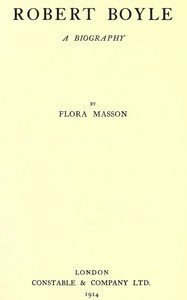
Robert Boyle : A biography by Flora Masson
Flora Masson's biography of Robert Boyle is a journey back to the birth of modern science. It starts not in a lab, but in the turbulent world of 17th-century Britain. We meet Boyle as a sensitive, sickly boy from a powerful family, shaped by the Irish Rebellion and a deep religious conversion. The story follows his move to Oxford and then London, where he joins a band of brilliant, curious men—the 'Invisible College' that would become the Royal Society.
The Story
This isn't a simple chronology of experiments. Masson weaves together Boyle's personal struggles with his public triumphs. We see him as a reclusive scholar, pouring his fortune into a private laboratory, driven by a dual mission: to understand nature through careful experiment (he helped establish the scientific method) and to see the glory of God in its mechanisms. The book walks us through his groundbreaking work on air pressure (yes, Boyle's Law), his writings on chemistry, and his debates with rivals. But it also shows his constant ill health, his refusal to marry, and his lifelong battle to reconcile faith with reason. The central thread is how this gentle, devout man navigated a world of political chaos and intellectual revolution to lay the foundations of chemistry.
Why You Should Read It
I loved this because it shatters the statue of a distant 'great scientist.' Masson, writing in 1914, had access to Boyle's personal letters and papers, and she uses them to show a real person. You feel the weight of his religious doubts, his frustration with flawed apparatus, and his generosity to other thinkers. The context is fantastic—you get the Great Fire of London, the plague, and royal drama as the backdrop to his quiet work. It makes you realize how radical it was to insist on proof over philosophy. Boyle comes across as humble, conflicted, and profoundly influential. It’s a human story about the birth of an idea: that we can test the world to understand it.
Final Verdict
Perfect for history buffs who like their science with a strong dose of personality, or for anyone curious about how we moved from alchemy to chemistry. It’s also a great pick if you enjoy biographies of complex, principled people. Be aware that Masson writes in an older style (it’s over a century old itself!), but it’s clear and engaging. This isn't a quick, pop-science read; it's a thoughtful, detailed portrait that rewards your attention. You'll close the book not just knowing about Boyle's Law, but feeling like you've met the man behind it.
Emma Anderson
7 months agoGood quality content.
Sarah Thompson
6 months agoGood quality content.