
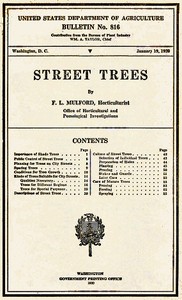
Street Trees by Furman Lloyd Mulford
Published in 1911, Street Trees is exactly what its title promises: a guide and a passionate argument for planting and caring for trees in our urban spaces. Author Furman Lloyd Mulford, a botanist and horticulturalist, writes not as a dry academic, but as a civic-minded neighbor who wants better, healthier, and more beautiful places for everyone to live.
The Story
There's no traditional plot with characters. Instead, the 'story' is Mulford's logical, step-by-step case for urban forestry. He starts by asking a simple question: why should we bother? His answers are practical and human-centered. Trees cool our streets in summer, break the cold wind in winter, clean the air, and even help property values. He then gets into the nitty-gritty: which tree species are best suited for harsh city conditions (hint: not all are!), how to plant them correctly so they thrive, and how to protect them from disease and damage. It's a blueprint for turning dusty, bare avenues into welcoming, green corridors.
Why You Should Read It
Reading this today is a fascinating experience. You get a direct line to the early 20th-century mindset on city planning and public welfare. Mulford's passion is contagious. He isn't just talking about botany; he's talking about community pride and public health. When he describes the 'cheerless' look of a treeless street versus the 'home-like' feel of a shaded one, you feel it. The most striking part is how modern his concerns sound. He worries about short-sighted cost-cutting, poor maintenance, and public apathy—issues every city still grapples with. It makes you look at every sidewalk tree with new respect, as a tiny piece of vital civic infrastructure.
Final Verdict
This is a perfect little read for anyone who loves their neighborhood, is interested in urban history, or is involved in local gardening or city planning. It's also great for nature lovers who feel that pull of green in the concrete jungle. While some of the specific science is dated, the heart of the book—the belief that trees make life better for everyone—is timeless. It's a quiet, powerful reminder that sometimes the simplest solutions (like planting a tree) are the most profound.
Karen Martin
5 months agoIf you enjoy this genre, the character development leaves a lasting impact. I will read more from this author.
Matthew Perez
1 year agoRead this on my tablet, looks great.



Amanda Lee
7 months agoThanks for the recommendation.