
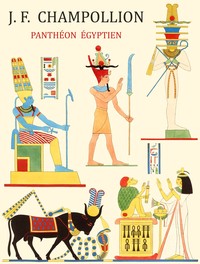
Panthéon égyptien : Collection des personnages mythologiques de l'ancienne…
Let's be clear from the start: this isn't a novel. 'Panthéon égyptien' is a foundational text, published in 1823, just a year after Champollion's famous breakthrough with the Rosetta Stone. Think of it as his first big attempt to show everyone what he'd found. The 'plot' is the unfolding of an entire spiritual universe.
The Story
The book is Champollion's organized guide to the gods and goddesses of ancient Egypt. He presents them almost like a catalog, grouping them by their roles and relationships. You meet the major players: the sun god Ra, the mummified lord of the dead Osiris, the magical Isis, the fierce protector goddess Sekhmet. But he doesn't just list names. He uses the hieroglyphs he'd just deciphered to explain their symbols—why Thoth has an ibis head, what the ankh really means, how the Egyptians saw the journey of the sun. He's piecing together a complete system of worship from temple walls and papyri that, until he came along, were just beautiful mysteries.
Why You Should Read It
Reading this is a unique experience. You're not getting a modern, polished summary. You're witnessing the birth of Egyptology as a science. You can feel Champollion's excitement and his meticulous mind at work. Sometimes his interpretations are a bit off—scholars have refined things since—and that's actually part of the charm. It shows the process of discovery, warts and all. It makes these distant, stone-carved figures feel human because you see a human (Champollion) struggling to understand them. The book connects you directly to the awe of the 1820s, when a lost civilization was suddenly shouting its stories from every monument.
Final Verdict
This is a must for anyone with a deep love for ancient Egypt who wants to go beyond TV documentaries. It's perfect for history buffs who enjoy primary sources and want to stand beside the pioneers. If you've ever visited the Egyptian gallery in a museum and wanted more context, Champollion is your guide. A word of caution: it's a 19th-century French text, so the language can feel formal. But push through that, and you'll find a captivating, firsthand account of one of history's greatest intellectual adventures. It's not a light beach read, but for the right person, it's absolutely magical.
Mason Perez
7 months agoRecommended.
Margaret Smith
1 year agoI started reading out of curiosity and the pacing is just right, keeping you engaged. Highly recommended.


Ava Moore
1 year agoRecommended.